
Fine-Pitch Wire Bonding for Advanced Packages
An in-depth technical guide to fine-pitch wire bonding for advanced semiconductor packages, covering ultra-dense interconnect challenges, materials, process control, failure modes, and backend manufacturing strategies for high-reliability applications.
Kiran
1/5/202610 min read
Fine-Pitch Wire Bonding for Advanced Packages: Physics, Process Control, Reliability, and Manufacturing Execution
Introduction
As semiconductor devices evolve toward higher functionality, greater integration density, and more demanding operating environments, backend assembly technologies are under unprecedented pressure. Increasing I/O counts, shrinking die sizes, heterogeneous integration, and strict cost and reliability targets have driven packaging engineers to push traditional interconnect methods to their physical and manufacturing limits. Within this landscape, fine-pitch wire bonding remains a critical, and often underestimated, technology.
Despite the rise of flip-chip, fan-out wafer-level packaging, and hybrid bonding, fine-pitch wire bonding continues to be widely deployed in advanced packages such as system-in-package (SiP), stacked-die assemblies, mixed-signal devices, automotive electronics, and industrial systems. Its continued relevance is not accidental. Fine-pitch wire bonding offers a unique combination of routing flexibility, proven reliability, and cost efficiency—provided it is executed with deep process understanding and disciplined backend control.
This article presents a comprehensive technical examination of fine-pitch wire bonding for advanced semiconductor packages, covering its physical foundations, material interactions, tooling requirements, ultrasonic energy control, failure mechanisms, inspection challenges, reliability considerations, and manufacturing strategies. The goal is not to present wire bonding as a legacy process, but to show how it has evolved into a precision micro-assembly technology operating near fundamental mechanical and materials limits.
Defining Fine-Pitch Wire Bonding in Modern Packaging
Fine-pitch wire bonding refers to wire bonding processes where the spacing between adjacent bond pads and wires is significantly reduced compared to conventional practice. While traditional wire bonding historically operated at pad pitches of 80–120 µm, fine-pitch applications typically fall within the 40–60 µm range, with ultra-fine pitch pushing below 40 µm, and in some research and niche production environments, approaching 30 µm or less.
At these pitches, wire bonding undergoes a qualitative transition. The process is no longer tolerant of variation. Small deviations in bond placement, ultrasonic energy, wire diameter, or loop geometry can lead to immediate yield loss or latent reliability failures. Fine-pitch wire bonding must therefore be treated as a tightly coupled system involving:
Die design and pad layout
Pad metallization and dielectric stack composition
Wire material and diameter
Bonding tool geometry and wear state
Ultrasonic energy density and temporal profile
Loop shape and height control
Mold flow dynamics and encapsulation stress
Each of these factors interacts nonlinearly with the others, and success depends on managing the entire system rather than optimizing individual parameters in isolation.
Why Fine-Pitch Wire Bonding Still Matters
The persistence of fine-pitch wire bonding in advanced packaging is driven by several fundamental advantages that alternative interconnect technologies do not fully replace.
Routing Flexibility
Wire bonding allows three-dimensional routing of electrical connections. This flexibility is invaluable in advanced packages where dies have non-uniform pad layouts, staggered rows, or heterogeneous technologies. In multi-die and SiP architectures, wire bonding enables interconnect strategies that would be prohibitively complex or expensive using purely planar interconnect schemes.
Cost and Infrastructure Efficiency
Fine-pitch wire bonding leverages existing backend infrastructure and tooling ecosystems. While advanced wafer-level interconnects often require significant capital investment and long development cycles, wire bonding enables faster iteration, lower non-recurring engineering costs, and economical low-to-medium volume production.
Reliability Track Record
Wire bonding has decades of field reliability data across consumer, automotive, industrial, and infrastructure markets. In applications where long-term reliability is paramount, proven behavior under thermal cycling, vibration, humidity, and electrical stress often outweighs theoretical performance gains offered by newer technologies.
Evolution Rather Than Obsolescence
Wire bonding has not stood still. Advances in bonder precision, materials science, ultrasonic control, and data analytics have continuously extended its applicability into regimes once thought impractical.
Evolution from Conventional to Fine-Pitch Wire Bonding
Early wire bonding processes were developed for relatively large bond pads, thick aluminum metallization, and generous spacing. Bonding recipes relied on wide process windows and mechanical robustness. As semiconductor scaling increased pad counts without proportional die size growth, this paradigm broke down.
The transition to fine-pitch wire bonding required fundamental advances in several areas:
Motion control: Sub-micron placement accuracy and repeatability
Vision systems: High-resolution pattern recognition for small pads
Tooling: Capillaries and wedges with smaller geometries and improved wear resistance
Materials: Thinner, more consistent wire with controlled mechanical properties
Process monitoring: Real-time feedback on ultrasonic energy delivery
What was once a mechanically forgiving process has become one that operates close to the limits of material strength, interfacial adhesion, and dielectric integrity.
Bond Pad Metallurgy and Dielectric Stack Sensitivity
Shrinking Pads and Reduced Contact Area
As pitch decreases, bond pad dimensions must shrink accordingly. Smaller pads reduce the available area for ultrasonic scrubbing and metallurgical bonding, increasing sensitivity to force and energy. At fine pitch, even slight over-bonding can damage pad edges or underlying structures.
Thin Metallization and Low-k Dielectrics
Advanced semiconductor nodes frequently employ thin aluminum or copper pads over low-k dielectric stacks. While these stacks improve electrical performance, they introduce mechanical fragility. Excessive bonding force or ultrasonic energy can cause:
Pad cratering
Subsurface dielectric cracking
Interfacial delamination
Critically, many of these defects are latent, escaping initial inspection and manifesting only during reliability testing or field operation.
At fine pitch, bonding processes must be designed around the weakest mechanical layer in the stack, not the strongest.
Wire Materials and Diameter Reduction
Mechanical Implications of Thinner Wire
Fine-pitch wire bonding relies on thinner wire diameters to reduce loop width and avoid shorts. However, reducing wire diameter has profound mechanical consequences:
Lower tensile strength
Increased stress concentration at the heel
Higher susceptibility to fatigue
Greater sensitivity to vibration and shock
These effects are magnified in copper wire systems due to copper’s higher stiffness compared to gold.
Electrical vs Mechanical Tradeoffs
Thinner wire improves electrical performance by reducing parasitics and enabling tighter routing, but it reduces mechanical robustness. Advanced packages must therefore balance signal integrity against long-term reliability, especially in automotive and industrial environments.
Ultrasonic Energy Density at Fine Pitch
Ultrasonic energy is the enabling mechanism for wire bonding, but at fine pitch it becomes a dominant risk factor.
As bond area decreases, ultrasonic energy density increases even if nominal power settings remain unchanged. This can result in:
Heel cracking
Pad cratering
Accelerated intermetallic growth
Localized overheating
Fine-pitch bonding therefore requires:
Lower ultrasonic amplitudes
Shorter bond times
Precise force-energy coupling
Extremely narrow process windows
Successful fine-pitch processes avoid compensating weak bonds with aggressive energy and instead rely on balanced parameter optimization.
Loop Profile Engineering
Loop Height Constraints
Fine-pitch designs often require lower loop heights to prevent wire-to-wire contact, reduce mold sweep risk, and meet package thickness limits. However, aggressive loop suppression increases stress at the heel and accelerates fatigue.
Advanced Looping Techniques
Modern bonders support sophisticated loop shaping, including reverse loops, flat loops, and variable loop heights across pad rows. These techniques allow dense routing while distributing mechanical stress more evenly—when implemented correctly.
Failure Modes Unique to Fine-Pitch Wire Bonding
Fine-pitch wire bonding introduces failure mechanisms that are rare or negligible at larger pitches.
Wire-to-Wire Shorts
Minimal spacing makes fine-pitch bonds vulnerable to shorts caused by placement error, loop variation, or mold flow. These failures are often catastrophic and difficult to rework.
Heel Cracking and Neck Fracture
Thinner wires and higher stress concentration significantly increase heel crack risk, particularly in copper wire systems. Cracks may remain latent until thermal or power cycling.
Pad Damage and Cratering
Thin pad stacks are easily damaged by ultrasonic over-drive. These defects often escape initial inspection and appear only during reliability testing.
Mold and Encapsulation Interactions
During encapsulation, fine-pitch wires are highly sensitive to resin flow forces. Mold compound viscosity, flow velocity, and gate design all influence wire sweep risk.
Mitigation strategies include:
Low-stress mold compounds
Optimized flow paths
Controlled injection profiles
Loop geometry designed for flow resistance
Ignoring mold-bond interactions can negate otherwise robust bonding processes.
Inspection and Metrology Challenges
As pitch decreases, inspection becomes more difficult:
Optical resolution limits are reached
Subsurface damage is hard to detect
Latent failures dominate
Manufacturers increasingly rely on high-magnification AOI, X-ray inspection, scanning acoustic microscopy, and process signature monitoring combined with data analytics.
Design-for-Manufacturability (DFM)
Fine-pitch wire bonding success is largely determined during design. Poor DFM decisions dramatically increase backend risk.
Key DFM considerations include:
Minimum pad size and spacing
Pad edge geometry
Metallization thickness
Consistent pad alignment
Designs optimized only for electrical performance frequently fail manufacturability requirements when pushed to fine pitch.
Qualification and Reliability Testing
Fine-pitch packages require rigorous qualification, including thermal cycling, power cycling, vibration, shock, and high-temperature storage. Many fine-pitch failures are latent, making reliability testing essential before volume production.
Yield Learning and Process Control
Fine-pitch wire bonding typically exhibits steeper yield learning curves. Stable production is achieved through structured DOE, tight SPC, and continuous feedback between inspection and bonding parameters. Aggressive scaling without maturity leads to instability and reliability escapes.
Fine-Pitch Wire Bonding vs Alternative Interconnects
While flip-chip and fan-out offer higher density, they also introduce higher cost, greater infrastructure complexity, and longer development cycles. Fine-pitch wire bonding often provides a pragmatic balance of performance, cost, flexibility, and reliability for many advanced packages.
Section: Ultra-Fine Pitch Wire Bonding Below 40 µm
As fine-pitch wire bonding moves below 40 µm, the process transitions from a yield-driven manufacturing challenge into a physics-limited assembly problem. At these dimensions, geometric tolerances, material behavior, and dynamic process interactions converge in ways that fundamentally restrict manufacturability.
Below 40 µm pitch, bond pad widths may fall below 25 µm, with edge-to-edge spacing of only a few microns. This dramatically increases sensitivity to bond placement error, tool wear, and thermal expansion mismatch between the die, substrate, and bonder mechanics. Even sub-micron drift in machine calibration can result in off-pad bonding or shorting.
Wire diameter reduction becomes unavoidable at ultra-fine pitch, often requiring diameters of 12–15 µm or less. These wires exhibit significantly reduced fatigue life and increased susceptibility to neck thinning, particularly under high ultrasonic energy density. Copper wire systems are especially constrained in this regime due to copper’s elastic modulus and reduced ductility relative to gold.
At ultra-fine pitch, process feasibility is often dictated less by nominal capability and more by statistical tail behavior. Rare placement errors or transient ultrasonic spikes that were previously inconsequential now result in immediate yield loss. As a result, ultra-fine pitch wire bonding typically demands aggressive derating of process windows and acceptance of lower theoretical throughput in exchange for stability.
Section: Tool Geometry, Capillary Design, and Wear Effects
Bonding tool geometry becomes a first-order determinant of success in fine-pitch wire bonding. Capillary inner diameter, outer diameter, chamfer angle, tip radius, and material composition all influence how ultrasonic energy is transmitted into the wire and bond interface.
At fine pitch, capillaries must be small enough to avoid encroaching on adjacent pads while still maintaining sufficient stiffness to transmit energy efficiently. This creates a tradeoff between spatial clearance and mechanical robustness. Smaller tools experience higher stress and accelerated wear, leading to geometry drift that directly impacts bond consistency.
Tool wear manifests as subtle changes in chamfer shape or surface roughness that alter wire deformation behavior. At coarse pitch, these changes may be tolerable. At fine pitch, they often result in increased heel cracking, inconsistent bond footprints, or elevated non-stick rates. Consequently, fine-pitch bonding operations typically require much shorter tool life limits and tighter inspection intervals.
Advanced backend lines often track tool usage at the individual capillary level, correlating wear metrics with bond quality data to proactively retire tools before yield degradation occurs.
Section: Copper vs Gold Wire at Fine Pitch Extremes
Material selection becomes increasingly consequential as pitch decreases. While copper wire offers superior electrical conductivity and cost advantages, its higher stiffness and oxidation sensitivity significantly narrow the process window at fine pitch.
Gold wire remains more forgiving due to its ductility, allowing effective bonding at lower ultrasonic energy and force. This makes gold more tolerant of thin pads and fragile dielectric stacks. However, gold’s susceptibility to intermetallic growth and its high cost limit its viability in high-temperature or cost-sensitive applications.
At extreme fine pitch, copper wire bonding often requires palladium-coated copper (PCC) to stabilize free-air ball formation and reduce oxidation-related variability. Even with PCC, copper systems demand tighter environmental control, lower ultrasonic amplitudes, and more conservative loop profiles.
In practice, many advanced packages adopt hybrid strategies, using gold wire for ultra-fine pitch signal bonds and copper or aluminum wire for power or ground connections where pitch is less constrained.
Section: Mold Flow Modeling and Wire Sweep Risk
At fine pitch, encapsulation becomes a dominant reliability risk. Mold flow forces that were negligible at larger pitch can displace fine wires, causing shorts, loop collapse, or latent mechanical stress.
Wire sweep risk increases with:
Reduced wire diameter
Higher loop heights
Narrow inter-wire spacing
High-viscosity mold compounds
Advanced backend manufacturing increasingly relies on computational mold flow simulation to predict wire displacement before tooling is finalized. These simulations inform gate placement, flow direction, and injection profiles that minimize wire interaction.
In fine-pitch packages, mold compound selection is often driven as much by rheological behavior as by thermal or moisture performance. Low-stress compounds with controlled flow characteristics are preferred, even if they impose tradeoffs elsewhere in the package design.
Section: Automotive and High-Reliability Fine-Pitch Constraints
Automotive and industrial applications impose reliability requirements that fundamentally change fine-pitch wire bonding strategies. Extended thermal cycling ranges, vibration exposure, and long service lifetimes magnify latent defects that might be acceptable in consumer electronics.
In these environments, fine-pitch wire bonding must be derated relative to theoretical capability. Conservative loop geometries, redundant bonds, and wider effective spacing are often employed even when die design supports tighter pitch.
Qualification for automotive applications frequently reveals failure modes that do not appear during standard JEDEC testing, such as progressive heel crack growth under combined thermal and vibration stress. These findings reinforce the need for application-specific reliability testing rather than generic qualification.
Section: Statistical Process Control and Yield Scaling
Fine-pitch wire bonding success is less about achieving a single “golden recipe” and more about maintaining statistical stability across millions of bonds. Yield loss at fine pitch is often driven by rare events rather than mean performance.
Advanced backend operations therefore rely heavily on:
Real-time SPC of ultrasonic energy signatures
Distribution monitoring rather than average values
Correlation of tool wear with defect rates
Early-warning thresholds well inside specification limits
Yield scaling at fine pitch is typically nonlinear. Early learning phases may show steep yield improvements, followed by plateaus where incremental gains require disproportionate effort. Understanding this behavior is critical for realistic ramp planning.
Section: Long-Term Reliability and Failure Propagation
Many fine-pitch wire bonding failures are not immediate opens or shorts, but progressive degradation mechanisms. Microcracks at the heel, marginal bond interfaces, or localized pad damage may remain dormant for months or years before propagating under service conditions.
Thermal cycling induces cyclic strain at the wire heel and bond interface, while power cycling introduces localized heating gradients. Over time, these stresses can cause crack propagation, resistance increase, and eventual electrical failure.
Fine-pitch packages therefore demand conservative design margins and robust backend process control to prevent reliability escapes that are difficult or impossible to detect during production testing.
Backend Manufacturing Support with Silicon Craft Technologies
Successfully implementing fine-pitch wire bonding for advanced packages requires more than capable equipment—it demands deep backend process expertise, disciplined execution, and close alignment between design and manufacturing. Silicon Craft Technologies provides engineering-driven backend semiconductor manufacturing support tailored to these challenges.
With hands-on experience in fine-pitch wire bonding, advanced package assembly, and failure-mode mitigation, Silicon Craft Technologies supports customers through process development, qualification, and low-to-medium volume production. Their collaborative approach emphasizes design-for-manufacturability alignment, ultrasonic energy optimization, loop profile control, and early identification of reliability risks specific to dense interconnects.
By bridging design intent with manufacturable reality, Silicon Craft Technologies enables stable yield, reduced risk, and long-term reliability for fine-pitch wire bonding in advanced semiconductor packages.
Conclusion
Fine-pitch wire bonding has evolved into a precision backend technology operating near fundamental mechanical and materials limits. As interconnect density increases and margins shrink, success depends on holistic control of materials, tooling, ultrasonic energy, loop geometry, and design decisions.
Rather than being displaced, fine-pitch wire bonding continues to adapt, offering a flexible, cost-effective, and reliable solution for advanced semiconductor packages when supported by strong backend expertise and disciplined manufacturing execution.
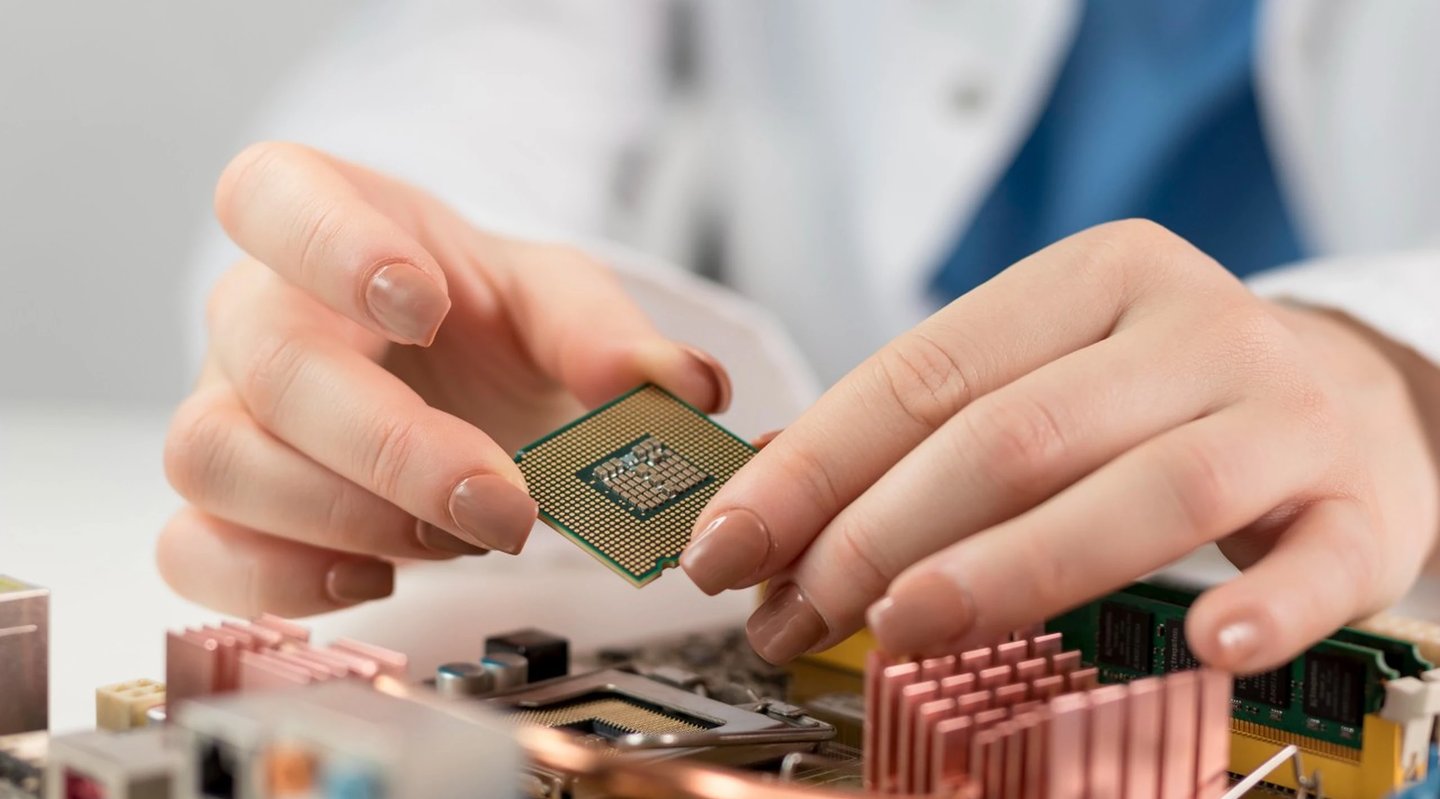
This image shows the handling of a fine-pitch semiconductor package during assembly, highlighting the precision required for advanced packaging and dense interconnect technologies such as fine-pitch wire bonding.