
When Wire Bonding Beats Flip-Chip
An expert comparison of wire bonding and flip-chip packaging, explaining when wire bonding delivers lower cost, greater flexibility, and superior reliability for modern semiconductor applications.
Kiran
1/6/20265 min read
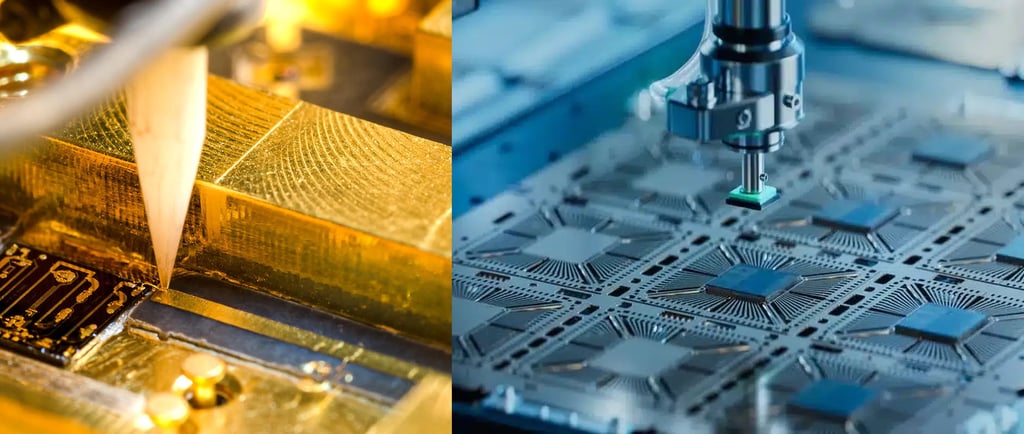
This collage compares wire bonding and flip-chip semiconductor packaging processes, highlighting differences in interconnect approach, die attachment, and backend assembly techniques.
When Wire Bonding Beats Flip-Chip: Choosing the Right Interconnect for Performance, Cost, and Reliability
Flip-chip packaging has become synonymous with high-performance semiconductor devices. Its short interconnects, high I/O density, and excellent electrical performance make it a compelling choice for many advanced applications. Yet despite its advantages—and the industry attention it receives—flip-chip is not always the best solution.
In many real-world products, wire bonding continues to outperform flip-chip when evaluated holistically across cost, reliability, flexibility, and manufacturing risk. From system-in-package (SiP) designs and mixed-signal devices to automotive electronics and low-to-medium volume production, wire bonding remains a preferred interconnect technology when applied in the right context.
This article explores when wire bonding beats flip-chip, examining the technical, economic, and reliability-driven factors that influence interconnect selection. Rather than framing the discussion as old versus new, the goal is to clarify where each approach delivers the greatest value—and why wire bonding remains indispensable in modern semiconductor packaging.
Understanding the Core Differences
At a high level, the difference between wire bonding and flip-chip lies in how the die connects to the package.
Wire bonding uses fine metal wires to connect die bond pads to package leads or substrates. The interconnect is three-dimensional, with compliant wire loops that can absorb mechanical and thermal stress.
Flip-chip places the die face-down on the substrate, using solder bumps or copper pillars to create direct electrical connections. The interconnect path is short and planar, offering superior electrical performance but requiring more complex materials and processes.
Both approaches are mature, well-understood technologies. The question is not which is “better,” but which is better for a given product.
Cost and Manufacturing Complexity
Lower Total Cost of Ownership
One of the most compelling reasons wire bonding beats flip-chip is total cost of ownership. Flip-chip requires:
Bump or pillar formation at wafer level
Underfill materials and dispensing processes
Tighter substrate tolerances
More complex inspection and rework
These steps add cost, tooling complexity, and yield risk—especially in lower-volume products.
Wire bonding, by contrast, leverages:
Simpler substrates
Fewer materials
Lower capital intensity
Established backend infrastructure
For products that do not require extreme electrical performance, wire bonding delivers acceptable functionality at significantly lower cost.
Yield Risk and Learning Curve
Flip-chip processes often exhibit steeper yield learning curves, particularly when new substrates, underfills, or die designs are introduced. Early yield loss can be substantial.
Wire bonding generally offers:
Faster yield stabilization
Easier root-cause analysis
Greater tolerance to design variation
This makes wire bonding especially attractive in products with frequent revisions or shorter lifecycles.
Design Flexibility and Layout Freedom
Non-Uniform Pad Layouts
Flip-chip works best with area-array pad layouts and regular bump patterns. However, many devices—particularly mixed-signal, RF, and MEMS—have irregular pad placement driven by circuit architecture or mechanical constraints.
Wire bonding excels in these cases because:
Pads can be placed at the die periphery or in staggered rows
Routing can adapt to asymmetrical layouts
Multiple dies with different pad schemes can be integrated
This flexibility is critical in system-in-package (SiP) designs and heterogeneous integration.
Late-Stage Design Changes
Wire bonding is more forgiving of late-stage design changes. Minor pad relocations or pitch changes often require only process adjustments rather than substrate redesign.
In flip-chip, even small changes may necessitate:
New bump masks
Substrate redesign
Underfill re-qualification
This agility gives wire bonding a decisive advantage in fast-moving development environments.
Mechanical Compliance and Reliability
Stress Management Advantages
Wire bonds act as compliant mechanical springs. This compliance helps absorb:
Thermal expansion mismatch between die and package
Mechanical shock and vibration
Board-level flexure
Flip-chip interconnects are rigid by comparison. Stress is transferred directly through solder joints, making flip-chip packages more sensitive to:
Thermal cycling fatigue
Warpage
Underfill integrity issues
In harsh environments, wire bonding often delivers superior long-term reliability.
Automotive and Industrial Applications
Automotive, industrial, and infrastructure electronics frequently prioritize reliability over peak performance. Wire bonding’s mechanical compliance and extensive field history make it well-suited for:
Wide temperature cycling ranges
Long service lifetimes
Vibration-prone environments
While flip-chip is used in automotive systems, it typically requires conservative design margins and extensive qualification.
Electrical Performance: When “Good Enough” Is Enough
Signal Speed and Parasitics
Flip-chip undeniably offers superior electrical performance:
Shorter interconnects
Lower inductance and resistance
Better high-frequency behavior
However, many products do not operate at frequencies where wire bond parasitics are limiting factors.
For applications such as:
Power management ICs
Sensor interfaces
Microcontrollers
Mixed-signal devices
wire bonding provides sufficient electrical performance without the added complexity of flip-chip.
Power and Ground Management
Wire bonding allows flexible placement of multiple power and ground bonds, enabling effective current distribution and redundancy. In some designs, this flexibility simplifies power integrity management compared to rigid bump arrays.
Volume and Lifecycle Considerations
Low-to-Medium Volume Products
Flip-chip economics strongly favor high-volume products where fixed costs can be amortized. In low-to-medium volume manufacturing, wire bonding often wins due to:
Lower NRE costs
Reduced tooling investment
Faster ramp-up
Many industrial, medical, and specialty devices fall squarely into this category.
Long Product Lifecycles
Products with long lifecycles benefit from wire bonding’s stability and supplier ecosystem. Flip-chip substrates, underfills, and bump processes may change over time, introducing obsolescence risks.
Wire bonding’s mature supply chain and standardized materials reduce long-term risk.
Fine-Pitch Wire Bonding Narrows the Gap
Advances in fine-pitch wire bonding have significantly narrowed the gap between wire bonding and flip-chip in terms of I/O density.
Modern wire bonding supports:
Pad pitches below 60 µm
Ultra-fine pitch designs below 40 µm
Thin wire diameters with controlled loop profiles
These capabilities enable high-density interconnects in packages that previously would have required flip-chip, while retaining wire bonding’s cost and reliability advantages.
Reworkability and Failure Analysis
Easier Rework
Wire-bonded packages are generally easier to rework:
Individual wires can be replaced
Localized defects can be corrected
Scrap rates can be reduced
Flip-chip rework is more complex and risky, often requiring full die removal and reattachment.
Failure Analysis Accessibility
Wire bonding provides better visibility for failure analysis. Bonds are accessible for:
Optical inspection
Pull and shear testing
Microsectioning
Flip-chip failures often occur beneath the die, complicating analysis and increasing turnaround time.
When Flip-Chip Still Wins
It is important to recognize where flip-chip clearly outperforms wire bonding:
High-performance processors
High-speed networking ASICs
Very high I/O count devices
Ultra-compact form factors
In these cases, the electrical and density advantages of flip-chip outweigh its costs and risks.
The key is not to default to flip-chip, but to justify its use based on actual requirements.
Decision Framework: Choosing the Right Interconnect
Wire bonding beats flip-chip when:
Electrical performance requirements are moderate
Design flexibility is critical
Mechanical reliability is a priority
Volumes are low to medium
Time-to-market and cost control matter
Flip-chip is favored when:
Extreme performance is required
I/O density is exceptionally high
Form factor constraints dominate
High volumes justify complexity
A disciplined, application-driven evaluation prevents overengineering and unnecessary cost.
Backend Manufacturing Support with Silicon Craft Technologies
Selecting between wire bonding and flip-chip—and executing that choice successfully—requires deep backend manufacturing expertise. Silicon Craft Technologies provides engineering-driven backend support to help customers make informed interconnect decisions.
With experience across wire bonding, advanced package assembly, and reliability qualification, Silicon Craft Technologies works closely with customers to evaluate design requirements, assess manufacturability, and optimize backend processes. Their collaborative approach supports low-to-medium volume production, process development, and transition from prototype to stable manufacturing.
By aligning interconnect strategy with real-world manufacturing constraints, Silicon Craft Technologies helps customers achieve reliable performance without unnecessary cost or risk.
Conclusion
Flip-chip is a powerful technology—but it is not universally superior. In many applications, wire bonding beats flip-chip by delivering the right balance of performance, flexibility, reliability, and cost.
As packaging complexity increases and product requirements diversify, the most successful designs are those that choose interconnect technologies based on practical needs rather than industry trends. When evaluated holistically, wire bonding remains a vital, competitive, and often optimal solution in modern semiconductor packaging.