
Wire Bonding Failure Modes
Learn the most common wire bonding failure modes in semiconductor packaging, their root causes, and practical strategies to detect, prevent, and improve long-term reliability.
Kiran
1/5/20265 min read
Wire Bonding Failure Modes: Causes, Detection, and Prevention in Semiconductor Packaging
Wire bonding remains one of the most mature and widely deployed interconnect technologies in semiconductor packaging. Despite the emergence of advanced interconnect approaches such as flip-chip and hybrid bonding, wire bonding continues to dominate many markets due to its cost efficiency, flexibility, and proven long-term reliability.
However, wire bonding is not immune to failure. As device geometries shrink, wire diameters decrease, materials diversify, and operating conditions become more demanding, wire bonding failure modes increasingly represent a critical yield and reliability risk.
Understanding how and why wire bonds fail—and how those failures can be detected and prevented—is essential for maintaining high manufacturing yield and meeting reliability requirements across consumer, automotive, industrial, and power electronics applications.
This article provides a comprehensive technical overview of common wire bonding failure modes, their root causes, inspection and detection methods, and practical strategies for prevention and control.
The Role of Wire Bonds in Package Reliability
Wire bonds serve as both electrical interconnects and mechanical structures. In addition to carrying signals and power, wire bonds must absorb thermal expansion mismatch between the die and package, tolerate vibration and mechanical shock, and survive thousands of thermal and power cycles over the product’s lifetime.
Because wire bonds are exposed elements within the package, they are particularly sensitive to:
Mechanical stress
Thermal cycling
Environmental conditions
Process variation
Failures in wire bonds can result in open circuits, intermittent connections, increased resistance, or catastrophic device failure.
Classification of Wire Bonding Failure Modes
Wire bonding failures are typically classified based on where and how the failure occurs. The most common categories include:
Bond interface failures
Wire-related mechanical failures
Metallurgical and material-related failures
Environmental and corrosion-related failures
Process- and handling-induced failures
Each category has distinct mechanisms and prevention strategies, though multiple failure modes may coexist in a single device.
Bond Interface Failures
Bond Lift (Non-Stick or Lift-Off)
Bond lift occurs when a bond separates from the bond pad or lead surface, resulting in an open circuit. It is one of the most frequently encountered wire bonding failures.
Common causes include:
Insufficient ultrasonic energy or bond force
Contaminated bond pads or leadframes
Oxidation on pad surfaces
Improper bonding temperature
Bond lifts may occur immediately after bonding (non-stick on pad) or after environmental stress testing due to weak initial bond formation.
Weak Bond Formation
Weak bonds may pass initial electrical testing but fail under thermal cycling, vibration, or mechanical stress. These failures are particularly dangerous because they are often latent.
Weak bonding is often linked to:
Marginal process windows
Tool wear or contamination
Inconsistent pad metallization quality
Wire-Related Mechanical Failures
Heel Cracking
Heel cracks form at the transition between the bonded region and the wire loop, typically near the first bond. This area experiences high mechanical stress during bonding and subsequent thermal cycling.
Contributing factors include:
Excessive ultrasonic energy
Over-deformation of the wire
Stiff wire materials (especially copper)
Aggressive loop profiles
Heel cracking is a common reliability concern in fine-wire and high-temperature applications.
Wire Breakage
Wire breakage can occur during bonding, molding, or field operation. Breaks may be caused by:
Excessive wire tension
Improper loop height or shape
Mechanical shock during handling
Fatigue from thermal or power cycling
Wire breakage often results in immediate device failure.
Wire Sweep and Shorting
During encapsulation or molding, wire bonds may deform or sweep due to resin flow forces. Excessive wire sweep can lead to:
Shorts between adjacent wires
Contact with package surfaces
Increased electrical parasitics
Wire sweep is strongly influenced by wire material, diameter, loop design, and molding conditions.
Metallurgical and Material-Related Failures
Intermetallic Compound Growth
Intermetallic compounds (IMCs) form naturally at the interface between the wire and bond pad. While some IMC formation is necessary for bonding, excessive growth can degrade bond integrity.
Examples include:
Gold–aluminum intermetallic growth leading to Kirkendall voiding
Brittle intermetallic layers causing crack propagation
IMC-related failures are accelerated by high temperatures and long operating lifetimes.
Corrosion-Induced Failures
Corrosion can attack wire bonds and bond interfaces, particularly in harsh environments with moisture or contaminants.
Corrosion mechanisms may involve:
Galvanic corrosion between dissimilar metals
Chloride contamination
Moisture ingress through package defects
Corrosion can increase resistance or cause complete bond failure.
Environmental and Reliability-Induced Failures
Thermal Cycling Fatigue
Repeated temperature changes cause expansion and contraction of materials with different coefficients of thermal expansion (CTE). Over time, this cyclic stress can fatigue wire bonds.
Common effects include:
Heel cracking
Bond interface degradation
Wire neck thinning
Thermal cycling fatigue is especially critical in automotive and industrial applications.
Power Cycling Stress
High-current devices experience localized heating during operation. Repeated power cycling can introduce mechanical stress in wire bonds, leading to fatigue and eventual failure.
Aluminum wires in power devices are particularly susceptible if not properly designed.
Process-Induced and Handling Failures
Tool-Induced Damage
Worn or contaminated bonding tools can damage bond pads or wires, leading to:
Inconsistent bond quality
Scratches or pad cratering
Increased defect rates
Regular tool inspection and replacement are essential to prevent these failures.
Pad Cratering
Pad cratering occurs when bonding force and ultrasonic energy damage the dielectric layers beneath the bond pad. This can lead to:
Latent cracks
Electrical leakage
Delayed failures
Pad cratering is more common in advanced nodes with low-k dielectrics and thin metallization stacks.
Inspection and Detection of Wire Bond Failures
Effective detection of wire bonding failures requires a combination of in-line inspection, destructive analysis, and reliability testing.
Common methods include:
Optical inspection for bond shape and placement
Pull testing and shear testing to assess bond strength
X-ray inspection for wire sweep and shorts
Scanning acoustic microscopy for delamination
Electrical continuity and resistance testing
No single method is sufficient; comprehensive inspection strategies are necessary to identify both immediate and latent defects.
Preventing Wire Bonding Failure Modes
Process Optimization
Stable wire bonding processes require tight control of:
Bond force
Ultrasonic energy
Bond time
Temperature
Loop profiles
Maintaining robust process windows reduces sensitivity to variation.
Material Selection
Choosing appropriate wire materials for the application is critical. Considerations include:
Electrical and mechanical requirements
Operating temperature
Pad metallization compatibility
Environmental exposure
Material mismatch is a frequent root cause of long-term failures.
Design for Reliability
Wire bond reliability must be considered at the design stage. Key design practices include:
Adequate bond pad size and spacing
Optimized loop geometry
Redundant bonds for high-current paths
Proper package and mold compound selection
The Impact of Advanced Packaging on Wire Bond Failures
As packages become more complex, wire bonds face new challenges:
Thinner wires and finer pitches
Higher operating temperatures
Tighter mechanical tolerances
In multi-die and heterogeneous packages, failure of a single wire bond can compromise the entire system, increasing the importance of defect prevention.
Data-Driven Reliability Improvement
Modern manufacturing increasingly relies on data analytics to identify trends and correlations in wire bonding failures. By combining:
Process data
Inspection results
Reliability test outcomes
manufacturers can proactively adjust processes before failures occur in the field.
Conclusion
Wire bonding failure modes remain a critical consideration in semiconductor packaging, even as interconnect technologies evolve. Failures such as bond lift, heel cracking, wire breakage, corrosion, and fatigue can significantly impact yield, reliability, and product lifetime.
By understanding the underlying mechanisms behind these failures—and by implementing disciplined process control, appropriate material selection, and reliability-focused design practices—manufacturers can significantly reduce risk and extend the viability of wire bonding across a wide range of applications.
Wire bonding may be a mature technology, but managing its failure modes requires continuous engineering attention, especially in today’s demanding semiconductor environment.
Backend Manufacturing Support with Silicon Craft Technologies
Managing wire bonding failure modes such as heel cracking, bond liftoff, intermetallic degradation, and corrosion requires more than isolated process fixes—it demands a deep understanding of backend assembly interactions, materials behavior, and reliability constraints. Silicon Craft Technologies provides engineering-driven backend semiconductor manufacturing support aligned with these challenges.
With experience across wire bonding processes, materials selection, and failure analysis, Silicon Craft Technologies works closely with customers to optimize bonding parameters, improve yield, and reduce reliability risks. Their collaborative approach supports process development, troubleshooting, and low-to-medium volume production, helping ensure robust wire bond performance from development through manufacturing.
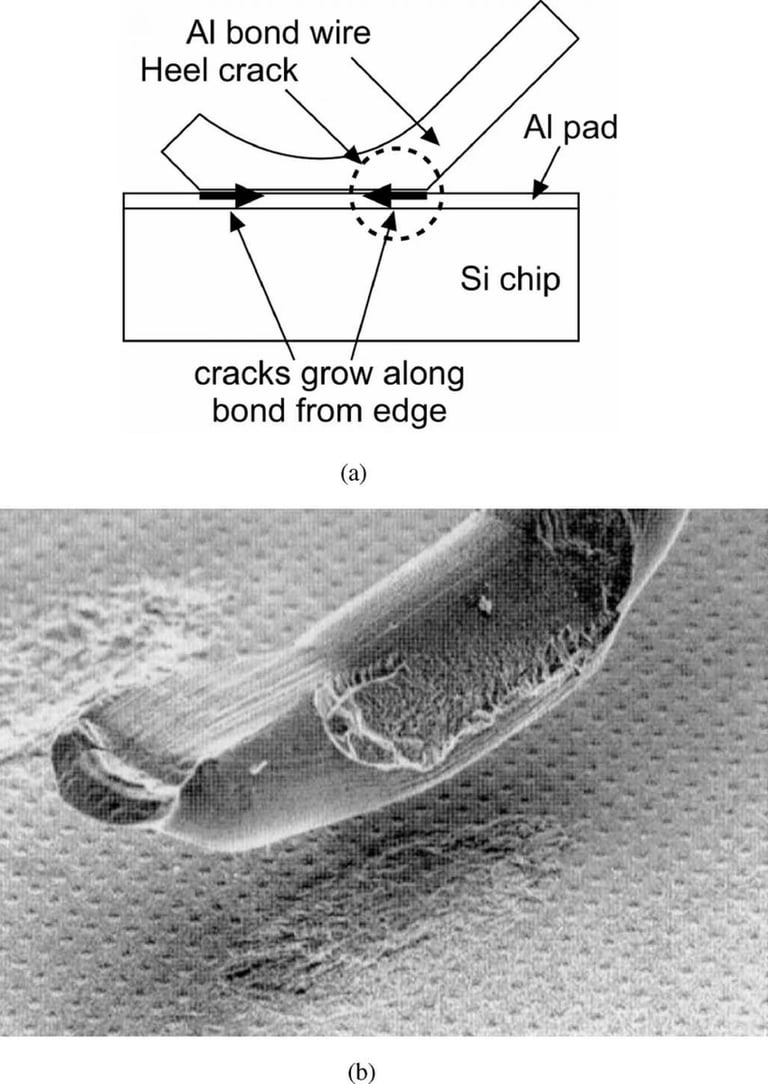
This image illustrates a wire bonding failure mode where heel cracking leads to crack propagation along the bond interface, ultimately causing bond liftoff and electrical failure in semiconductor packages.