
Wire Bonding Process Optimization
A comprehensive deep-dive into wire bonding process optimization, covering materials, equipment control, inspection, reliability testing, and manufacturing strategies to maximize yield and long-term package reliability.
KIran
1/6/202612 min read
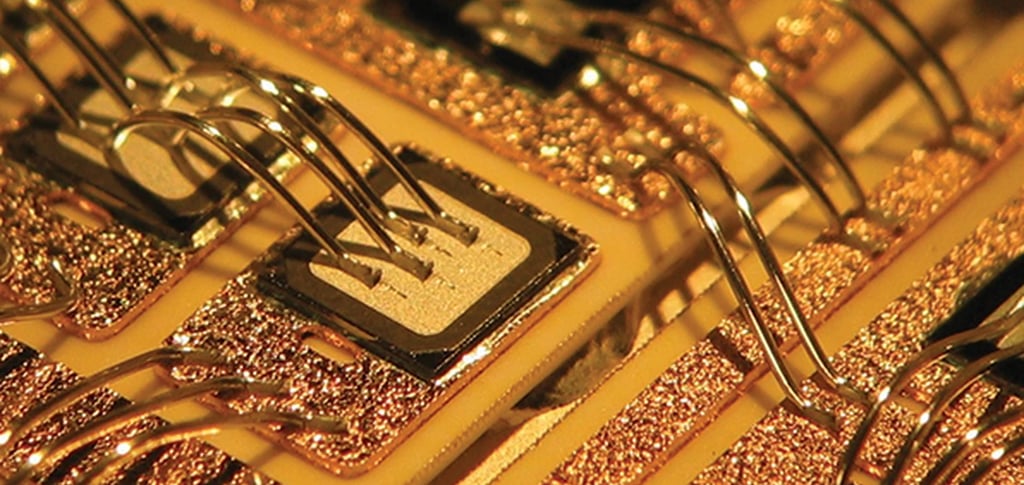
This image shows fine-pitch wire bonding on gold pads, illustrating critical interconnect structures optimized for high-density semiconductor packaging and reliable electrical performance.
Wire Bonding Process Optimization: Building Robust, High-Yield, and Reliable Backend Assembly Processes
Wire bonding remains the dominant interconnect technology in semiconductor backend manufacturing, not because it is simple, but because it is adaptable. Across logic, analog, power, MEMS, automotive, and industrial devices, wire bonding continues to succeed where other interconnect technologies struggle with cost, flexibility, or reliability. However, as device geometries shrink, materials evolve, and reliability expectations intensify, wire bonding has transitioned from a forgiving process into one that demands disciplined optimization.
Wire bonding process optimization is no longer about achieving bonds that pass basic electrical or mechanical tests. It is about constructing stable, repeatable, reliability-driven manufacturing systems that perform consistently across equipment sets, material lots, environmental conditions, and product lifecycles. Marginal processes may appear acceptable in early testing but often fail during qualification, volume ramp, or field operation. Optimization is therefore the difference between short-term success and long-term manufacturability.
This article presents a comprehensive examination of wire bonding process optimization, addressing physical mechanisms, material interactions, equipment behavior, inspection strategy, reliability validation, and production scalability. The goal is not to provide a recipe, but to establish a framework for thinking about optimization as a system-level discipline.
Understanding What “Optimization” Really Means in Wire Bonding
In many manufacturing environments, optimization is misunderstood as parameter tuning. Engineers adjust ultrasonic power, bond force, or time until pull strength improves, and the process is declared optimized. In reality, this approach often masks underlying weaknesses rather than eliminating them.
True optimization means:
The process remains stable over time
Small disturbances do not produce catastrophic failures
Failure modes are predictable and acceptable
Reliability performance aligns with application requirements
An optimized wire bonding process is one where variation is controlled, not merely averaged out.
Physical Mechanisms Governing Wire Bond Formation
Wire bonding relies on the interaction of force, ultrasonic energy, and temperature to create intimate contact between two metal surfaces. This interaction produces plastic deformation, oxide disruption, and atomic diffusion, resulting in a metallurgical bond.
The relative contribution of each mechanism depends on:
Wire material and diameter
Pad metallurgy and thickness
Surface condition
Equipment dynamics
Optimization requires understanding which mechanism is dominant and how aggressively it must be driven without causing collateral damage.
Excessive focus on bond strength alone often leads to overdriving ultrasonic energy, which improves immediate test results but introduces latent damage such as pad cratering or heel cracking. Optimized processes seek minimum effective energy, not maximum measurable strength.
Wire Bonding Methods and Their Optimization Implications
Ball bonding and wedge bonding are both mature technologies, but they behave very differently under optimization.
Ball bonding introduces thermal energy into the process, reducing material yield strength and facilitating intermetallic formation. While this provides a wider process window, it also accelerates intermetallic growth and increases sensitivity to pad stack weakness.
Wedge bonding relies more heavily on ultrasonic energy and mechanical interaction. This makes it particularly sensitive to surface condition, oxide thickness, and tool wear. Optimization in wedge bonding often requires tighter environmental and tool controls than ball bonding.
Processes optimized for one method rarely translate directly to the other.
Wire Material Selection as an Optimization Constraint
Wire material selection fundamentally shapes the optimization landscape.
Gold wire offers excellent ductility and a wide bonding window, making it forgiving during process development. However, its softness can mask pad weaknesses, and its cost drives many manufacturers toward alternatives.
Copper wire introduces higher stiffness and stronger oxide formation, narrowing the process window significantly. Optimization must account for increased bonding force requirements and reduced tolerance for surface contamination.
Palladium-coated copper wire improves oxidation resistance but introduces additional interfacial complexity that must be validated through reliability testing.
Optimized processes are always wire-specific. Recipes must be treated as material-dependent, not interchangeable.
Pad Metallurgy as a Primary Limiting Factor
As device scaling progresses, pad metallurgy increasingly defines the boundary between successful bonding and failure. Thin aluminum pads on low-k dielectrics cannot tolerate the same energy levels as legacy pad stacks.
Optimization must consider:
Pad thickness and hardness
Adhesion layer integrity
Dielectric mechanical strength
In many advanced devices, pad damage—not bond weakness—is the dominant failure mechanism. Process optimization must therefore protect the pad even if it means accepting lower pull values.
Ultrasonic Energy Optimization and Control
Ultrasonic energy is the most influential and most dangerous bonding parameter. It is responsible for oxide disruption and interfacial scrubbing, but it is also the primary source of subsurface damage.
Modern optimization strategies move away from static ultrasonic setpoints and toward energy control philosophies:
Lower amplitudes over longer durations
Controlled energy ramping
Signature-based monitoring
The objective is consistent energy coupling, not brute-force oxide removal.
Bond Force Optimization and Stress Management
Bond force determines the degree of plastic deformation and stress transfer into the pad and underlying dielectric. Excessive force improves immediate adhesion but increases the risk of cratering and subsurface fracture.
Optimized force settings account for:
Wire stiffness
Pad hardness
Die thickness
Equipment response time
Force optimization cannot be separated from ultrasonic optimization; the two parameters are tightly coupled.
Thermal Effects and Temperature Optimization
Temperature lowers material yield strength and promotes diffusion but also accelerates intermetallic growth and thermal degradation mechanisms.
Optimization strategies favor:
The lowest temperature that enables stable bonding
Uniform thermal distribution
Tight heater calibration control
Temperature is often used as a crutch to compensate for poor surface condition or material incompatibility. Optimized processes minimize reliance on elevated temperatures.
Tooling Geometry, Wear, and Maintenance
Bonding tools define how energy and force are delivered to the bond interface. Small changes in capillary or wedge geometry can significantly alter bond behavior.
Tool wear introduces gradual, often unnoticed drift in process performance. Optimization must include:
Defined tool life limits
Regular inspection and replacement
Correlation between tool age and bond metrics
No amount of parameter tuning can compensate for worn tooling indefinitely.
Loop Profile Optimization and Mechanical Compliance
Wire loop geometry affects both manufacturability and reliability. Low loops reduce wire sweep and package height but increase stress concentration at the heel. Higher loops improve compliance but increase the risk of interference and sweep.
Optimized loop profiles are validated not just at bonding, but after molding, thermal cycling, and vibration testing.
Fine-Pitch Wire Bonding Optimization Challenges
Fine-pitch designs dramatically amplify all optimization challenges. Reduced pad area increases stress density, while reduced spacing increases shorting risk.
Optimization in fine-pitch environments demands:
Thinner wire
Lower bonding energy
Tighter equipment control
Enhanced inspection sensitivity
At fine pitch, yield loss is often driven by rare excursions rather than average behavior.
Heavy Wire and Power Device Optimization
Power devices require a different optimization mindset. Heavy wire bonding prioritizes current capacity and fatigue resistance over density.
Optimization focuses on:
Controlled deformation geometry
Uniform bond footprints
Resistance to thermal cycling
Failures are often delayed, making reliability-driven optimization essential.
Environmental and Cleanliness Controls
Environmental conditions directly affect oxide formation and surface contamination. Humidity, airborne particles, and handling discipline all influence bondability.
Optimized environments control:
Humidity levels
Wire exposure time
Surface cleanliness
Improving environmental control often widens the process window more effectively than adjusting bond parameters.
Multi-Die and System-in-Package Optimization
SiP architectures introduce variability in die height, pad metallurgy, and thermal behavior. Optimization must be die-specific, not package-wide.
Bonding order, loop routing, and recipe segmentation are critical to achieving stable results.
Failure Mode Engineering as an Optimization Tool
Rather than eliminating failure, optimized processes control how failure occurs. Wire breaks are generally preferable to pad lifts or dielectric fractures.
Engineering failure modes provides confidence that worst-case scenarios fail safely rather than catastrophically.
Inspection, Metrology, and Feedback Loops
Optimization is meaningless without feedback. Visual inspection, pull and shear testing, acoustic imaging, and cross-sectioning all contribute to understanding process behavior.
Trends matter more than single data points. Optimized processes rely on failure mode distributions, not just average values.
Statistical Process Control and Data-Driven Optimization
SPC transforms optimization from an event into a continuous discipline. Monitoring force drift, ultrasonic signature changes, and failure mode shifts allows early intervention.
Data-driven optimization replaces intuition with evidence.
Reliability Validation as the Final Gate
Processes that pass initial tests but fail under thermal, mechanical, or environmental stress are not optimized. Reliability testing validates whether optimization decisions were correct.
Wire Bonding Optimization as a Continuous Discipline
Wire bonding optimization is never finished. Materials evolve, equipment ages, and product requirements change. The most successful manufacturing organizations treat optimization as an ongoing discipline supported by data, engineering judgment, and cross-functional collaboration.
When approached systematically, wire bonding remains not only viable, but exceptionally competitive in modern semiconductor packaging.
Automotive-Grade Wire Bonding Process Optimization
Automotive semiconductor applications impose some of the most demanding requirements on wire bonding processes. Unlike consumer electronics, automotive devices must survive wide temperature swings, extended lifetimes, vibration, and electrical stress while maintaining functional stability. Optimization in this context is fundamentally reliability-first, not yield-first.
Automotive optimization prioritizes:
Failure mode predictability over peak strength
Conservative energy margins
Long-term metallurgical stability
Thermal cycling from −40 °C to +150 °C repeatedly stresses the wire heel, bond interface, and pad stack. Processes optimized only for room-temperature pull strength often fail under these conditions due to fatigue-induced cracking or intermetallic embrittlement.
Automotive wire bonding optimization typically includes:
Reduced ultrasonic energy to limit subsurface damage
Increased loop compliance to absorb thermal expansion mismatch
Redundant power and ground bonds
Extended stress testing during qualification
Processes that survive automotive qualification are often overqualified for other markets, but the reverse is rarely true.
MEMS-Specific Wire Bonding Optimization Strategies
MEMS devices introduce mechanical sensitivity that fundamentally alters optimization priorities. Unlike digital ICs, MEMS performance can be directly affected by packaging-induced stress, vibration, and residual strain.
Optimization for MEMS wire bonding focuses on:
Minimizing die excitation during bonding
Preventing stress transfer into moving structures
Preserving sensor calibration
Ultrasonic energy that is acceptable for logic devices can permanently shift MEMS sensor characteristics. As a result, MEMS optimization often involves:
Lower ultrasonic amplitude
Shorter bond times
Modified tool engagement profiles
Loop routing is also critical. Wires must avoid cavities, suspended structures, and lids while maintaining sufficient compliance. Optimization is validated not only electrically, but through functional MEMS performance testing before and after environmental stress.
Optimization for RF and High-Frequency Devices
RF devices introduce optimization constraints driven by electrical parasitics rather than mechanical robustness. While wire bonding is sometimes viewed as inferior to flip-chip for RF, optimized wire bonding can perform exceptionally well when properly designed.
Key RF optimization considerations include:
Loop inductance control
Consistent wire length and shape
Stable ground reference bonds
Optimization often involves intentional trade-offs:
Slightly higher mechanical stress may be acceptable to reduce inductance
Multiple parallel ground wires may be added to stabilize impedance
In RF applications, process repeatability is more important than absolute loop geometry perfection. Small variations can shift impedance and degrade performance.
Optimization for Long-Term High-Temperature Operation
High-temperature operating life (HTOL) testing often exposes weaknesses in wire bonding processes that appear robust at room temperature. Elevated temperatures accelerate:
Intermetallic growth
Grain boundary diffusion
Oxide migration
Optimization for high-temperature operation focuses on:
Controlled intermetallic formation
Avoiding brittle phase dominance
Stable bond interfaces over time
Processes optimized purely for initial strength often fail HTOL due to excessive intermetallic growth leading to embrittlement and cracking. Optimized processes aim for balanced intermetallic morphology, not maximum growth rate.
Copper Wire Optimization: Advanced Considerations
Copper wire bonding optimization deserves special attention due to its increasing adoption and inherent challenges. Copper’s stiffness, rapid oxidation, and narrow bonding window make optimization significantly more complex than gold.
Advanced copper wire optimization strategies include:
Controlled atmosphere bonding to limit oxidation
Palladium-coated wire selection based on pad metallurgy
Lower ultrasonic amplitude combined with higher force
Copper optimization is especially sensitive to:
Tool geometry
Pad hardness
Surface cleanliness
Even small variations in copper wire batch properties can require recipe adjustments. As a result, copper processes demand tighter incoming material control than gold-based processes.
Optimization Through Design-for-Manufacturing Collaboration
Wire bonding optimization cannot be isolated from design decisions. Many backend process challenges originate from front-end design choices that ignore manufacturing realities.
Optimization improves dramatically when:
Pad size and thickness are designed with bonding in mind
Pad placement avoids mechanically weak regions
Metallurgy selections align with available wire materials
Design-for-manufacturing collaboration allows optimization to occur before silicon is taped out, rather than relying on backend workarounds.
Optimization During Process Transfer and Ramp-Up
Processes optimized during development often degrade during production ramp due to:
Equipment variation
Operator differences
Environmental changes
Successful ramp optimization includes:
Golden-tool-based recipe transfer
Cross-equipment correlation testing
Controlled volume increases
Skipping these steps often results in yield loss that is misattributed to random variation rather than incomplete optimization.
Data Analytics and Machine Learning in Wire Bonding Optimization
Advanced manufacturing environments increasingly leverage data analytics to enhance optimization. Modern bonders generate vast amounts of process data, including force profiles, ultrasonic signatures, and motion traces.
Optimization benefits from:
Pattern recognition in failure mode trends
Early detection of tool wear
Predictive maintenance scheduling
Machine learning does not replace engineering judgment, but it enhances the ability to detect subtle shifts that humans might miss.
Optimization Metrics That Actually Matter
Many organizations optimize toward the wrong metrics. Pull strength alone is insufficient.
Meaningful optimization metrics include:
Failure mode distribution stability
SPC trend tightness
Post-stress performance retention
Tool-to-tool variability
Optimized processes produce boring data: narrow distributions, stable trends, and predictable outcomes.
Common Pitfalls That Prevent True Optimization
Several recurring mistakes prevent organizations from achieving true optimization:
Chasing higher pull numbers instead of failure mode control
Ignoring pad damage because it is not immediately visible
Treating optimization as a one-time activity
Over-adjusting parameters instead of fixing root causes
Avoiding these pitfalls often yields greater gains than parameter tuning alone.
Wire Bonding Optimization as Competitive Advantage
In a mature industry, competitive advantage rarely comes from using the newest technology. It comes from executing established technologies better than others.
Organizations that treat wire bonding optimization as a strategic discipline benefit from:
Higher yield stability
Faster product ramps
Lower field failure rates
Greater customer confidence
Wire bonding, when optimized correctly, remains one of the most powerful and adaptable interconnect technologies available.
Final Perspective on Wire Bonding Process Optimization
Wire bonding process optimization is not a checklist or a recipe—it is a mindset. It requires understanding the physical limits of materials, respecting mechanical constraints, using data intelligently, and validating decisions through reliability testing.
As semiconductor packaging continues to evolve, wire bonding will remain relevant not because it is simple, but because it can be optimized intelligently to meet new challenges.
Organizations that invest in deep optimization capability will continue to extract value from wire bonding long after others declare it obsolete.
Mold Compound Interaction and Post-Bond Process Optimization
Wire bonding does not exist in isolation. Even a perfectly optimized bonding process can fail if downstream processes are not considered during optimization. Among these, mold compound interaction is one of the most common sources of latent wire bond failures.
Mold flow introduces mechanical forces that can:
Deform wire loops
Induce heel stress
Cause wire-to-wire contact or shorting
Exacerbate weak bond interfaces
Optimization must therefore include validation under actual molding conditions. This often reveals that loop profiles that appear stable before molding fail afterward due to flow-induced displacement.
Effective optimization strategies include:
Loop height tuning to balance compliance and stability
Mold flow direction alignment with wire orientation
Gate placement optimization to reduce peak flow velocity near wires
Mold compound selection with appropriate viscosity and filler content
Wire bonding processes that are optimized without considering molding often show excellent initial yield but poor long-term reliability.
Optimization for Thin and Ultra-Thin Wire Applications
As pitch continues to shrink, wire diameters have followed. Ultra-thin wires introduce new optimization challenges due to reduced mechanical margin and increased sensitivity to handling and stress.
Thin wire optimization focuses on:
Precise force control to avoid necking
Reduced ultrasonic amplitude to prevent wire fracture
Smooth loop trajectories to minimize localized stress
Unlike thicker wires, thin wires fail abruptly and often catastrophically. There is little warning before yield loss occurs, making tight process control essential.
Inspection strategies must also evolve, as visual defects become harder to detect and pull test margins narrow significantly.
Equipment Aging and Long-Term Process Drift
One of the most underestimated factors in wire bonding optimization is equipment aging. Over time, bonders experience gradual changes in:
Transducer efficiency
Actuator response
Heater accuracy
Mechanical backlash
These changes do not occur suddenly, which makes them difficult to detect without proper monitoring. Optimization must therefore include aging compensation strategies, such as:
Scheduled recalibration intervals
Golden-tool comparisons
Long-term SPC trend analysis
Processes optimized on new equipment may slowly drift out of control if aging effects are not accounted for.
Tool-to-Tool Matching and Fleet Optimization
Scaling an optimized process across multiple bonders introduces additional complexity. Even when tools are nominally identical, small differences in calibration and wear can produce measurable variation.
Fleet-level optimization includes:
Establishing a reference tool baseline
Quantifying acceptable variation limits
Adjusting recipes per tool rather than forcing uniformity
Organizations that insist on a single recipe across unmatched tools often experience unexplained yield differences that are mistakenly attributed to materials or operators.
Wire Bonding Optimization Under Vibration and Shock Loads
Many applications—particularly automotive, aerospace, and industrial—subject wire bonds to vibration and mechanical shock. These conditions stress wire heels and bond interfaces in ways not captured by standard pull testing.
Optimization for vibration resistance includes:
Increased loop compliance
Avoidance of sharp heel geometries
Balanced bond deformation
Failure under vibration is often fatigue-driven rather than strength-driven. Processes optimized only for static strength frequently underperform in dynamic environments.
Electrical Stress and Electromigration Considerations
Electrical stress introduces additional optimization constraints, particularly for high-current or high-duty-cycle devices. Elevated current density accelerates electromigration and thermal cycling at the bond interface.
Optimization strategies include:
Increasing effective bond area
Using multiple parallel wires for current sharing
Selecting wire materials with higher electromigration resistance
Ignoring electrical stress during optimization can lead to failures that only appear late in product life.
Optimization for High-Mix, Low-Volume Manufacturing
Not all optimization occurs in high-volume environments. Many semiconductor manufacturers operate high-mix, low-volume production lines where frequent product changeovers are unavoidable.
Optimization in these environments emphasizes:
Fast recipe setup and verification
Robust processes with wide tolerance
Minimal dependence on manual adjustments
Highly fragile processes may achieve excellent yield on a single product but fail when frequent transitions introduce variability.
Human Factors and Operator Influence
Even in highly automated environments, human interaction influences wire bonding outcomes. Operator handling of wire spools, tool changes, and setup procedures introduces variability that must be addressed during optimization.
Effective strategies include:
Standardized setup protocols
Training focused on failure mechanisms, not just procedures
Clear escalation paths when abnormalities are detected
Optimization that ignores human factors often collapses under real production conditions.
Incoming Material Control as an Optimization Lever
Wire bonding optimization assumes consistent materials, yet incoming variation in wire, substrates, or die can undermine even the best processes.
Material-related optimization practices include:
Incoming wire mechanical property verification
Surface condition audits
Lot-to-lot correlation testing
Early detection of material variation prevents unnecessary process adjustments and protects long-term stability.
Optimization Validation Through Accelerated Stress Testing
Accelerated stress testing bridges the gap between process optimization and real-world performance. Tests such as thermal cycling, power cycling, and humidity exposure reveal whether optimization decisions truly improve robustness.
Optimized processes demonstrate:
Stable failure modes after stress
Minimal degradation in mechanical strength
Consistent electrical performance
Processes that degrade rapidly under stress were never truly optimized.
Optimization Documentation and Knowledge Retention
One of the most overlooked aspects of optimization is documentation. Knowledge lost due to personnel changes or undocumented adjustments often forces teams to re-learn the same lessons repeatedly.
Effective optimization programs maintain:
Clear rationale for parameter choices
Historical data trends
Failure analysis records
Documentation transforms optimization from tribal knowledge into institutional capability.
Wire Bonding Optimization as a Living System
Wire bonding optimization is not a static achievement. Changes in materials, equipment, product requirements, and customer expectations continuously reshape the process landscape.
Organizations that succeed long-term treat optimization as:
An ongoing engineering discipline
A data-driven feedback loop
A core manufacturing competency
When optimization is embedded into daily operations rather than treated as a project, wire bonding becomes a stable, predictable, and highly competitive interconnect solution.
Backend Manufacturing Support with Silicon Craft Technologies
Wire bonding process optimization requires more than equipment expertise; it demands system-level understanding of materials, mechanics, and reliability interactions. Silicon Craft Technologies provides engineering-driven backend manufacturing support to help customers develop and sustain optimized wire bonding processes.
With experience across wire bonding materials, fine-pitch optimization, pad metallurgy interactions, and reliability qualification, Silicon Craft Technologies works collaboratively with customers to establish stable operating windows, mitigate latent risks, and transition optimized processes into production.
By aligning optimization strategy with real manufacturing constraints, Silicon Craft Technologies enables higher yield, improved reliability, and long-term process resilience.